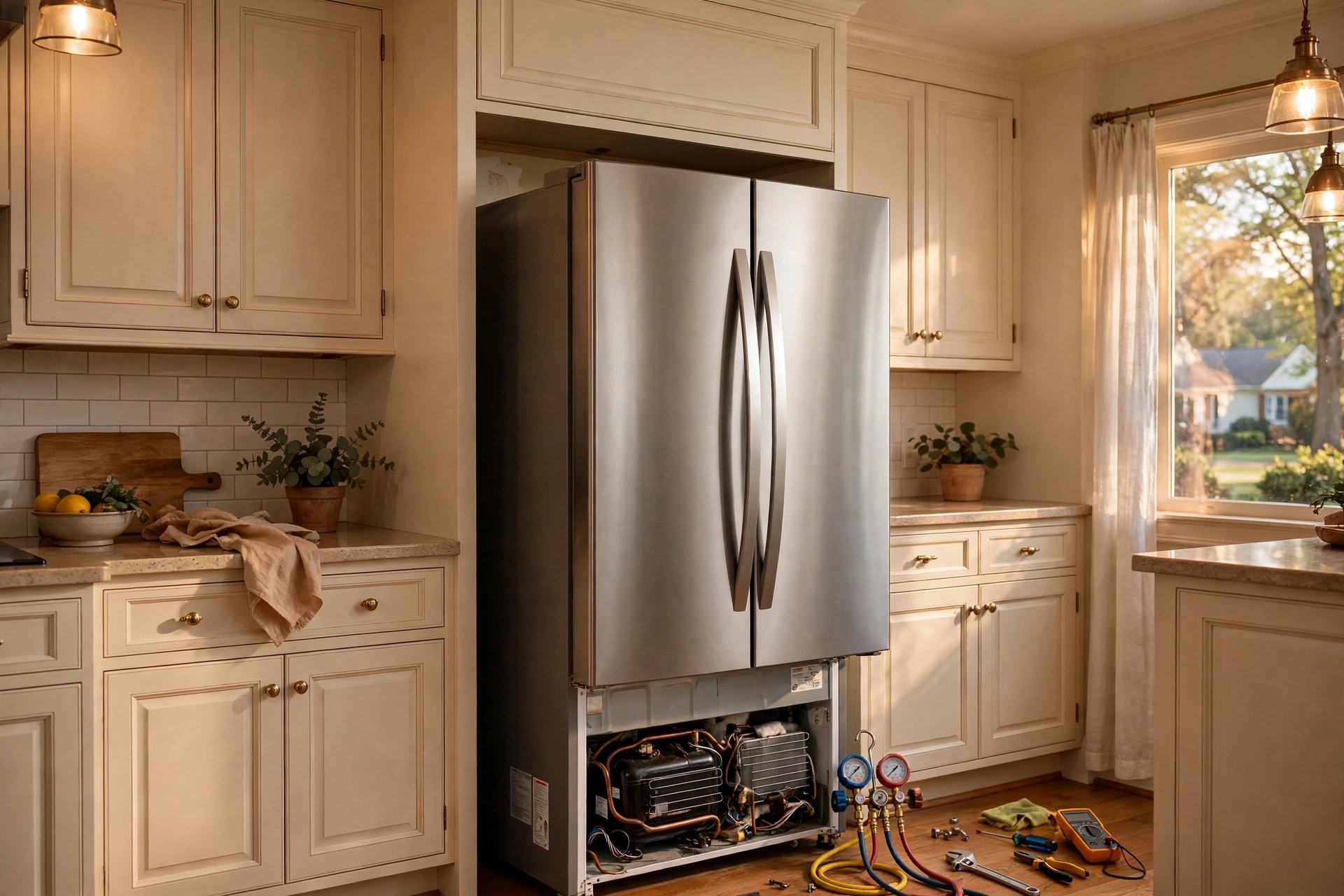
Sealed System and Compressor Repair in Bowie, Maryland, with published price ranges up front, the fault confirmed by diagnosis before we quote the repair, and one written figure before any work begins.
Sealed System and Compressor Repair in Bowie, MD by Bowie Appliance Repair Company
Inside every refrigerator and freezer, a sealed loop of tubing, coils, and a compressor moves refrigerant in a circle that never stops while the machine has power. We repair sealed systems and compressors for Bowie homeowners, the deepest level of refrigeration work.
Trouble here rarely looks dramatic at first. Cooling fades over days, run times stretch longer, and a garage refrigerator or basement freezer in Belair starts losing ground during the first hot spell of summer.
What the Sealed System Is and How It Fails
The loop has four working parts. The compressor squeezes refrigerant gas through the condenser coils, where heat leaves the system. The refrigerant then passes through a narrow restriction into the evaporator coils, where it expands, turns cold, and absorbs heat from the cabinet. A filter drier traps moisture and debris.
Failure can strike any point. Compressors wear out electrically or mechanically, losing the ability to build pressure. Refrigerant escapes through tiny leaks at joints or coils, and a system low on charge cools weakly however hard the compressor runs. Confirming which failure is present takes pressure and temperature testing, not a guess from the doorway.
A Regulated Part of the Trade
Sealed system work is regulated at the federal level, because refrigerant must never be vented into the air. Federal rules under EPA Section 608 govern how refrigerant is recovered, handled, and charged, and those rules bind the individual doing the work. Recovery equipment captures the existing charge before the loop is opened.
How a Sealed System Repair Proceeds
Testing opens the job. Pressures on both sides, temperature splits across the coils, and compressor current draw together show whether the fault is the compressor, the charge, or a restriction. Where a leak is suspected, the search comes before any recharging, because adding refrigerant to a leaking system buys weeks, not a repair.
A failed compressor is then replaced along with the filter drier, which is changed any time the loop is opened. The evacuated system is recharged to specification, with cabinet temperatures watched across hours rather than minutes.
Recent Project: Sealed System and Compressor Repair in Belair
BEFOREAFTER
A Belair refrigerator had cooled weakly for weeks and finally stopped holding safe temperatures, its compressor running almost without pause. Testing showed the compressor drawing abnormal current and failing to build proper pressure, while the charge was intact and no leak was found. We recovered the refrigerant, replaced the compressor and filter drier, evacuated the system, and recharged it to specification. The refrigerator returned to steady temperatures and normal cycling across a full day of monitoring.
Turnaround
One main visit for the repair, with temperature monitoring through the following day.
Final Price
$470
Sealed System and Compressor Repair Cost in Bowie, MD
No Bowie company publishes a local price list, so these figures are published figures, labeled as such. Published guides put sealed system and compressor repair at $320 to $680 for most jobs. General refrigeration repairs average about $255 in those guides, and the average appliance repair overall is about $179 per job, so sealed work sits well above ordinary refrigeration jobs.
Depth explains the gap: this repair opens a regulated system, replaces its most expensive component, and demands hours of evacuation and charging. A diagnostic visit commonly runs $75 to $125 in published guides and is usually credited toward the repair.
Compressor Repair or a New Refrigerator?
Economics decide this one, and Bowie housing tilts the answer. A freestanding refrigerator with a failed compressor late in its life usually points toward replacement. A built in or counter depth unit in a Woodmore or Mitchellville kitchen points the other way, because replacing it can mean cabinet work too.
Request an Appliance Repair Quote in Bowie, MD
Use the quote form at the bottom of this page and describe the cooling pattern: how long the decline has run, and whether the compressor runs constantly or not at all. Send the form and we will follow up.
Frequently Asked Questions
How much does sealed system and compressor repair cost in Bowie, MD?
Published figures put most sealed system and compressor repairs at $320 to $680, against a general refrigeration average of about $255. A diagnostic visit commonly runs $75 to $125, usually credited toward the repair.
How do I know if my compressor has failed?
Signs include a cabinet warming while the compressor runs constantly, or a compressor clicking repeatedly without starting. Low refrigerant or a restriction can imitate both, so pressure and electrical testing confirms the cause.
Can a refrigerant leak just be topped off?
Topping off without finding the leak is temporary, not a repair, since the added charge escapes through the same opening. A lasting repair fixes the leak, then evacuates and recharges the system.
Why must the filter drier be replaced with the compressor?
The drier traps moisture and debris inside the sealed loop, and a saturated drier left in place will damage a new compressor over time, so it is replaced whenever the loop is opened.
Is sealed system work regulated?
Yes. Refrigerant handling is regulated at the federal level under EPA Section 608, which governs recovery, handling, and charging, and binds the individual performing the work.
Is it worth repairing a compressor on an older refrigerator?
It depends on the machine around the compressor. A sound cabinet, healthy seals and fans, and a built in format favor repair; multiple failing systems on an aging unit favor replacement.
Get Your Appliance Repair Quote
Tell us which appliance is failing and how. We read every request that comes in and respond with the published range for that kind of repair and the next step, starting with a diagnostic visit to confirm the fault.
Prefer to talk it through first? Send the form and we will call you back at the number you give us.